
Stop Guessing, Start Diagnosing: Why Your Business Doesn’t Need Another Quick Fix
Most entrepreneurs don't diagnose their business issues—they reflexively prescribe quick fixes. Discover why growth without diagnosis is dangerous and how adopting a diagnostic mindset can save your enterprise.
Stop Guessing, Start Diagnosing: Why Your Business Doesn’t Need Another Quick Fix
Before You Touch Another Business Topic… Stop Prescribing Quick Fixes For Yourselves
Tired of surface-level fixes? Learn why scaling a broken business accelerates failure, and discover how a diagnostic framework can solve your root problems.
Most entrepreneurs don't diagnose their business issues—they reflexively prescribe quick fixes. Discover why growth without diagnosis is dangerous and how adopting a diagnostic mindset can save your enterprise.
Before You Touch Another Business Topic… Stop Prescribing Quick Fixes
Imagine walking into a doctor's clinic. You wouldn't walk up to the receptionist and demand, "Give me some medicine." Instead, the doctor begins with a structured diagnosis:
-
Where does it hurt?
-
How long has it been happening?
-
What have you tried so far?
Only after examining your symptoms, running tests, and identifying the root cause does the doctor prescribe a targeted treatment. Now, imagine if businesses were treated the same way. Unfortunately, they rarely are. Most entrepreneurs don't diagnose their business issues—they reflexively prescribe surface-level fixes:
-
Sales falling? Increase advertising.
-
Profits shrinking? Cut costs abruptly
-
Customers leaving? Launch an emergency discount
-
Competition rising? Slash your prices.
These actions may temporarily relieve symptoms, but they seldom solve the underlying problem. Just as a headache can stem from stress, dehydration, or poor eyesight, declining revenue is rarely the real issue. It is merely a symptom of something deeper.
-
A struggling sales department may actually suffer from a positioning problem.
-
Cash flow crunches often trace back to a flawed pricing strategy.
-
Poor customer retention is rarely a service issue—it's usually a customer selection problem.
Businesses Don’t Fail Overnight: The Danger of Unnoticed Decline
Very few businesses collapse in a single day. Decline usually happens quietly, eroding health from the inside out:
-
A few key customers stop buying.
-
Margins become razor-thin.
-
Expenses slowly creep upward.
-
Cash flow becomes unpredictable.
-
The founder works longer hours while stress multiplies.
By the time leadership realizes something is seriously wrong, the warning signs have been present for months—sometimes years. The true failure wasn't a lack of hustle or effort; it was a lack of accurate business diagnosis.
Why Growth Without Diagnosis Is Dangerous
Many entrepreneurs dream about scaling their operations—more customers, more employees, more branches, and more revenue. However, growth without understanding is one of the fastest ways to multiply existing problems.
-
A business that cannot consistently serve 100 customers well will struggle exponentially harder with 1,000.
-
A weak pricing model doesn’t magically improve with higher sales volume.
-
An inefficient process only becomes more expensive as you scale.
Scaling amplifies strengths, but it also magnifies weaknesses. Before you accelerate your growth strategy, you must first understand your baseline.
Welcome to the Diagnostic Mindset
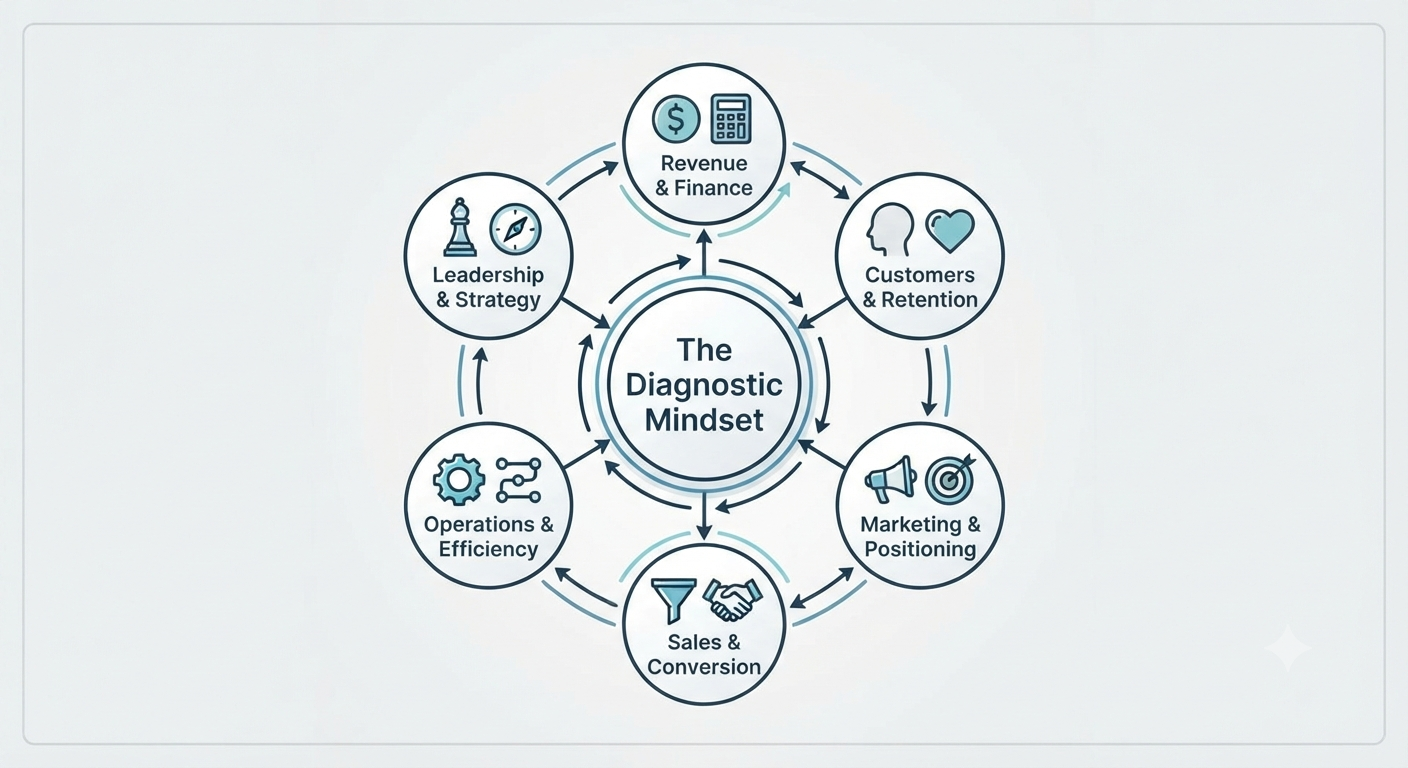
Most business books teach you how to market harder, sell more, or hire smarter. A true growth framework takes a radically different approach: It helps you discover what your business actually needs. Rather than offering generic advice, a strategic diagnostic evaluates your organization across its most critical dimensions:
-
Revenue & Finance
-
Customers & Retention
-
Marketing & Positioning
-
Sales & Conversion
-
Operations & Efficiency
-
Leadership & Strategy
The Three Questions Every Leader Must Answer
As you assess your enterprise, keep returning to three fundamental questions:
-
What is actually happening in my business?
-
Why is it happening beneath the surface?
-
What is the next most important improvement we need to make?
The most successful entrepreneurs aren't just the ones who work the hardest; they are the ones who spot patterns early, ask better questions, and diagnose before they decide. When you learn to look past surface-level metrics and evaluate your business with diagnostic clarity, you stop relying on guesswork. You build stronger systems, create healthier operations, and scale an enterprise that not only grows—but endures.
Ready to Find Your Blind Spots?
If you are tired of guessing what your business needs next, it's time to stop treating symptoms and start implementing a systematic diagnostic framework.
What is the single biggest performance bottleneck in your company right now—and how do you plan to diagnose it this quarter?